
Threat Newsletter November 23, 2026

This was the week autonomous offense stopped being a slide in a conference talk. Google's threat intel team documented an attacker framework turning patches into working exploits with no human involved, and the European Commission spent ten-plus days fighting an intrusion where CERT-EU says the agent-driven tool ARTEX was in play. At the same time, AI-assisted research produced two "patch now" bugs in software that sits in almost every enterprise — Java4Shell in OpenJDK and nginx2root in NGINX — which shrinks the gap between disclosure and weaponization even further. The other thread is trust in the stuff we load without thinking: Optimizely's snippet CDN served skimmers to 178 brands, Microsoft's agent-framework package on PyPI shipped a credential stealer, and n0n leaked bank and card-network customer data through vendors nobody has named yet.
Vulnerabilities & Exploitation
Java4Shell: critical OpenJDK bug opens Jira, Jenkins, Keycloak and friends to pre-auth RCE
Calif disclosed CVE-2026-114938, a memory-corruption bug in OpenJDK's hardware-accelerated Base64 decoder on x86-64 CPUs with AVX-512 VBMI. Specially crafted Base64 input can leak memory or lead to code execution, and the team demonstrated unauthenticated takeovers of apps like Jenkins, Jira, Confluence and Keycloak. Oracle and OpenJDK shipped fixes on Nov 17; CISA publicly urged immediate patching.
Key takeaways
- Affected: OpenJDK 17.0.6 and later, plus downstream builds (Oracle Java SE, Amazon Corretto, Eclipse Temurin, Microsoft Build of OpenJDK, Azul Zulu, Red Hat OpenJDK and others). ARM64 hosts aren't affected. Check each distributor's own fix schedule.
- Can't patch today? Calif's mitigation is starting the JVM with
-XX:-UseBASE64Intrinsics(or-XX:UseAVX=2to disable AVX-512 entirely). - There's no universal payload — each app needs its own path to the decoder — so prioritize internet-facing Java apps that decode attacker-supplied Base64 (auth headers, tokens, uploads). Scoring varies: 9.2 under CVSS 4.0 from Calif, 8.1 under CVSS 3.1 from Oracle.
 Lawrence Abrams

nginx2root: five NGINX memory bugs, one reachable on a plain static-file server
Xint disclosed five memory-safety flaws in NGINX (CVE-2026-123007, -123633, -123634, -121810, -113425), and F5 shipped out-of-band fixes on Nov 18. The headline bug, CVE-2026-123007, is an HTTP/2 flow-control integer issue dating back to 2015 that an unauthenticated attacker can reach on any HTTP/2-enabled server. The researchers chained the NGINX bugs with a Linux kernel flaw to get host root. F5 rates all five 9.2 (CVSS 4.0).
Key takeaways
- Upgrade to NGINX Open Source 1.30.7 (stable) or 1.31.9 (mainline); NGINX Plus fixes for CVE-2026-123007 are in 37.0.8.1 and 37.3.0.1. Some earlier Plus builds fix only CVE-2026-123633, so check carefully.
- Distro packages lag: several reports show RHEL and Ubuntu nginx builds still vulnerable at disclosure. Inventory by actual running version, not "we patched last month."
- Stopgap: disabling HTTP/2 blocks only the two HTTP/2 bugs, not the HTTP/3, resolver and mail-proxy ones. A public PoC exists for CVE-2026-123007 and fake exploit repos are circulating on GitHub — vet before you run anything.
 Bill Toulas
CISA adds four exploited flaws to KEV — including a LiteLLM guardrail escape
On Nov 18, CISA added four actively exploited bugs to KEV: Synology DSM (CVE-2024-10441), LiteLLM (CVE-2026-40217), Apache Axis 1.x (CVE-2026-90436) and REDCap (CVE-2026-90817). The LiteLLM bug lets code in the custom guardrail test feature escape its sandbox and run on the proxy — the box that usually holds every model API key. Rapid7 saw the Axis flaw exploited inside a Confluence Data Center environment.
Key takeaways
- LiteLLM: upgrade to 1.83.11+ and treat any exposed proxy as a key-theft risk; rotate model provider keys if you can't rule out compromise.
- Apache Axis 1.x is discontinued with no upstream fix — find it via your vendors (for Confluence Data Center, upgrade to 9.2.28 or an unaffected 10.x).
- Synology DSM: get management interfaces off the internet and check for new admin accounts and unfamiliar scheduled tasks. REDCap: confirm versions if you run public surveys. Federal deadlines: Nov 21 for Synology/Axis/REDCap, Dec 2 for LiteLLM.
 The Hacker News

Puppet Server RCE (CVE-2026-115731) is now on KEV
CISA added CVE-2026-115731 to KEV on Nov 17. It's a deserialization bug in how Puppet Server processes agent reports: any client holding a CA-signed agent certificate can run code on the server. Perforce patched it on Nov 3 alongside CVE-2026-115732, a certificate-name authorization bypass, and a public PoC has been available since disclosure.
Key takeaways:
- Patch to Puppet Enterprise 2026.0.1, 2025.12.1 or 2023.8.13, or Puppet Core 9.1.3 / 8.22.2. Community open-source Puppet won't get a fix — the path is OpenVox or Puppet Core.
- If autosigning is enabled, treat this as unauthenticated. Review autosign config now.
- A popped Puppet server can grab the CA signing keys and push config to your whole fleet. Hunt for unusual commands spawned by the puppetserver service account and unexpected catalog changes since early November.
 Ionut Arghire

NoisyTCP: an 11-year-old Linux kernel race that crashes hosts remotely
Researcher Hyunwoo Kim disclosed CVE-2026-99288, a race in the Linux kernel's TCP code that lets an unauthenticated attacker crash a server just by sending crafted traffic to a listening service like NGINX, Apache or SSH. It's been in the kernel since 2015 and affects nearly every distro. Because the bug is in the kernel, crashing a containerized web server takes down the whole host.
Key takeaways
- Fixed upstream Nov 3 and in stable kernels 6.12.117, 6.18.63 and 7.3.4. Several major distros (RHEL 8–10, Ubuntu) had no fixed kernel at disclosure — track your vendor.
- Workaround: disable SYN cookies (per network namespace, so every container) or serialize RX queues — both have trade-offs against SYN floods and throughput.
- Detection: watch for kernel panics with a NULL pointer dereference in
tcp_v4_rcv/ IPv6 equivalent. Red Hat rates it 7.5; it's DoS, not RCE, but it's a cheap way to take out shared cloud nodes.
 Sergiu Gatlan

Supply Chain
OPTIMJACK: Optimizely's CDN served skimmers and crypto clippers to 178 brands
On Nov 16, an attacker abused a flaw in Optimizely Web Experimentation's account signup flow to plant malicious JavaScript in customers' "Project JavaScript" field, which Optimizely's own CDN then served to site visitors. Report URI found the code in 188 snippets across 178 organizations, including CNN, BBC, Zoom, Salesforce and GitLab. Payloads swapped crypto wallet addresses and skimmed payment data; Optimizely says it fixed the bug and removed the code, and that fewer than 5% of customers were affected.
Key takeaways
- If you run Optimizely Web Experimentation, open every project's Project JavaScript field and confirm you wrote everything in it. Injection window reported roughly 04:21–23:11 UTC on Nov 16.
- Third-party script exposure is your problem even when the vendor gets popped. Revisit CSP, Subresource Integrity where feasible, and script-change monitoring on checkout and wallet pages.
- Report URI ties the same actor's injector infrastructure to activity going back to September, so assume this wasn't a one-off.
 Lawrence Abrams

Microsoft's agent-framework PyPI package shipped a credential stealer
Two malicious releases of Microsoft's official agent-framework Python package (1.26.1 and 1.26.2) hit PyPI on Nov 17, roughly half an hour apart, and were live for under an hour. Each dropped a .pth file that runs on every Python start — even if nothing imports the package — and harvested environment secrets, cloud and package-manager credentials, and CI identity tokens. The package sees around 200,000 monthly downloads; Microsoft hasn't said how the attacker got publish access.
Key takeaways
- 1.26.0 is the last clean release. Hunt for
agent_framework_meta.pth,af_runtime_diag.pth/af_runtime_diag.pyin site-packages. - If either bad version ran anywhere, treat every secret reachable from that host as burned — Azure CLI, AWS, GitHub, Docker, npm/pip creds, Hugging Face and OpenAI keys.
- Rotating stored secrets doesn't revoke already-issued OIDC tokens. Review Azure DevOps and GitHub Actions federated credentials and token activity for Nov 17 onward.
 Bill Toulas

Malicious QBase update forces Bundeswehr to ground Quantum Systems drones
German drone maker Quantum Systems confirmed that attackers breached its network in late October and pushed a malicious file through the update server for QBase, its ground-control and mission-planning software. The file reached customer servers, including the Bundeswehr's, and the German military briefly grounded its Quantum drones and pulled them from an exercise. The company says the threat was contained; sources told AFP that early signs point to Russia.
Key takeaways
- Classic update-channel compromise — exactly the scenario code signing and staged rollout are supposed to catch. Ask your OT/defense vendors how they'd detect an unscheduled update.
- If you consume vendor updates into sensitive environments, verify signatures and stage updates in an isolated test environment before they hit production systems.
- Initial access and how many customers installed the file are still undisclosed — watch for a fuller post-mortem.
 Bill Toulas

Fireworks AI fallout keeps spreading: Uber notifies ~149K, Cursor traces malicious extension
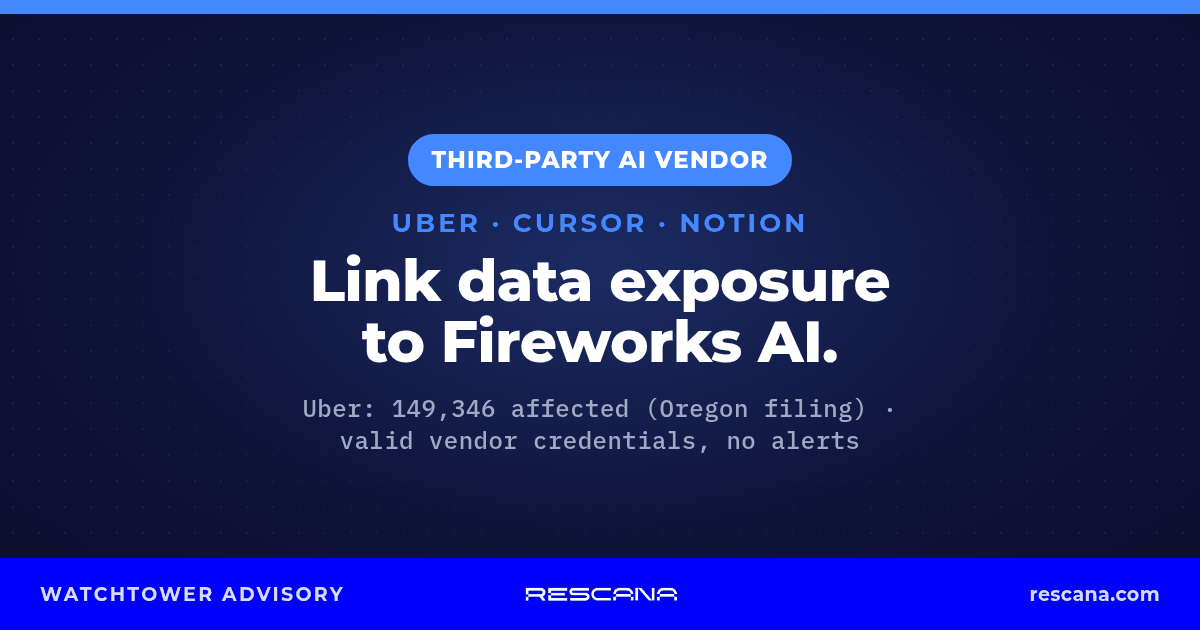
The fallout from AI inference provider Fireworks' October breaches widened. Uber filed state breach notices covering 149,346 people whose data, including driver's license numbers, sat in a storage environment set up for a service provider — later identified as Fireworks. Cursor said an attacker used an access key it had issued to Fireworks to copy coding-agent traces that held some unredacted credentials, then used one of those to publish a tampered Claude Code extension.
Key takeaways
- Inventory every key, bucket and dataset you've shared with AI vendors for training or evals. Scope them read-only, time-limit them, and scrub secrets from traces before sharing.
- Uber says its alerts didn't fire because the attacker used the vendor's legitimate credentials — baseline normal vendor access patterns so you can spot abuse.
- If you installed Cursor's Claude Code extension around late October, check Cursor's advisory for affected versions.
 Rescana
AI Security & Threat Actors
Google: attackers ran an AI framework that turned patches into exploits with no human in the loop
GTIG and Mandiant's latest AI Threat Tracker describes "exploit_agent," a multi-agent framework found on an exposed staging server that diffed web software before and after patches, wrote exploits and launched them on its own. Config comments were in Russian and victim telemetry pointed at French websites. GTIG also saw multi-agent frameworks like ARTEX, CAIRN, CyberStrikeAI and PentAGI used in live intrusions, though it hasn't seen end-to-end autonomous zero-day pipelines against real targets.
Key takeaways
- Assume your n-day window on internet-facing web apps is now hours, not weeks. Prioritize patch SLAs for exposed services.
- Google notes these tools trade stealth for speed — noisy scanning, IP rotation, buggy exploit attempts. That's detection opportunity; tune WAF and edge logging to catch bursts of exploit attempts against freshly patched bugs.
- Watch your own cloud for this too: Mandiant saw a financially motivated actor deploy an autonomous attack framework inside a victim's compromised cloud environment.
 Prasanth Aby Thomas

European Commission hit for 10+ days; CERT-EU links ARTEX
Politico reported that a cyberattack disrupted European Commission HR, payroll, leave, medical-reimbursement and translation systems for more than ten days. CERT-EU detected international attackers using ARTEX, a publicly available AI-driven pentesting framework, though it hasn't named the actor, the entry point, or the exact role ARTEX played. Whether staff personal data was stolen is still being assessed.
Key takeaways
- ARTEX went from a GitHub release in July to an FBI FLASH alert on Nov 13 and now a confirmed hit on an EU institution. Pull CERT-EU's Nov 5 note and the FBI FLASH into your detection backlog.
- Agentic frameworks move fast from foothold to privileged access (the FBI cited intrusions under three hours). Tighten alerting on rapid recon-to-privesc sequences rather than single events.
- Back-office systems (HR, payroll) are juicy and often under-monitored. Make sure they're in scope for your EDR and identity telemetry.
 Carly Page

Typosquatters register lookalikes the day after brands launch campaign domains
Symantec found that whenever clients of brand-protection registrars CSC or MarkMonitor registered a new campaign domain, a one-letter lookalike appeared the next day through a China-based registrar. It happened 27 times across brands including Abbott, Bayer, CarMax, McDonald's, P&G and Sanofi, targeting rebate, sweepstakes and legal-settlement sites where people type URLs by hand and hand over personal details.
Key takeaways
- When marketing or legal launches a campaign domain, register the obvious one-character variants at the same time.
- Feed newly registered domain monitoring with your upcoming campaign names, not just your core brand.
- Symantec warns the ad-network traffic behind these could pivot to malvertising and credential harvesting — block NRDs at the proxy where you can.
 Sead Fadilpašić

Breaches & Extortion
n0n leaks JPMorgan, Visa and Mastercard customer data via unnamed vendors
Extortion group n0n listed JPMorgan Chase, Visa and Mastercard among 59 victims on Nov 16 with a 48-hour deadline, then published marketing and cardmember data on Nov 19. The firms say third-party vendors were breached, not their core systems: Chase says exposed data may include names and emails, Mastercard reports limited data from one benefits program, and Visa points to an Asia-Pacific provider with no card numbers affected. None of them has named the vendor.
Key takeaways
- Expect targeted phishing against premium cardholders using this data. Brief your fraud and help-desk teams and warn execs who carry premium cards.
- n0n is a data-theft-only crew (no encryption) that's claimed roughly 200 victims since September, per eCrime.ch data cited by Reuters. Add its leak site to your monitoring.
- Push your own marketing and CX vendors on what customer data they hold and how quickly they'd tell you about a breach.
 Reuters

La Poste subsidiary Maileva breach exposes 22 million people in France
La Poste subsidiary Maileva breach exposes 22 million people in France
Summary: La Poste confirmed that a September attack on Maileva, a business-mail platform under its Docaposte arm, exposed names and postal addresses of about 22 million people — roughly a third of France. Maileva sends letters for social housing providers, hospitals and employers, so many affected people won't know they were customers. France's cybercrime unit is investigating and the CNIL has been notified; La Poste says bank details weren't affected.
Key takeaways
- Expect convincing postal and letter-themed scams in France — some reporting says certain payment reminder letter contents were accessed.
- If you use hybrid-mail or print-and-post providers, ask what document content they retain and for how long.
- Classic fourth-party problem: recipients had no relationship with the breached vendor. Map which vendors process your customers' correspondence.
 Alessandro Mascellino
SBC Medical: two incidents expose data on 1.6M people in Japan
SBC Medical Group, which manages clinics including Shonan Beauty Clinic, disclosed two incidents affecting customer and employee data in Japan. Stolen database records covered about 1.624 million people and could include names, contact details, birth dates, patient card numbers and passwords — Japanese reporting says the passwords were stored unencrypted. Around 20,000 employee accounts were also affected.
Key takeaways
- Plaintext passwords mean credential-stuffing risk for any reused accounts. If you run consumer services in Japan, watch for stuffing spikes.
- The company's booking service was also affected — a reminder to include partner platforms in breach scoping.
- Check your own stack: no app should be storing passwords reversibly in 2026.
 Secure.com
Law Enforcement
Ukraine and FBI arrest four in AI-voice "IT support" ransomware crew tied to $40.5M
Ukrainian police, working with the FBI over a two-year investigation, arrested four suspected key members of a ransomware group that at least 28 companies paid more than $40.5 million. The crew posed as IT support using a custom platform that sent AI-generated voice messages, talked employees into handing over credentials or installing remote-access tools, then stole data and encrypted systems. The wider network includes former Conti members, but police haven't confirmed the four suspects' affiliations.
Key takeaways
- Help-desk impersonation is still the front door. Make sure staff know IT will never ask them to install remote tools from a cold call, and give them a simple callback-verification path.
- Alert on new RMM/remote-access tool installs that don't come from your sanctioned deployment process.
- AI voice lowers the cost of these campaigns — expect more volume, not fewer attempts, even after these arrests.
 Lawrence Abrams

Scattered Spider's Tyler Buchanan gets six years; Lapsus$'s Arion Kurtaj pleads guilty
Tyler Buchanan, a 24-year-old Scot tied to Scattered Spider, was sentenced in the US to six years for an SMS phishing and SIM-swap scheme that stole at least $11.6 million in crypto — the last of five defendants sentenced. In London, Lapsus$ member Arion Kurtaj pleaded guilty to the 2022 Rockstar Games breach that leaked GTA 6 footage, plus attacks on Uber, Revolut and BT/EE; sentencing is set for Nov 23.
Key takeaways
- Neither case was technically sophisticated — smishing, SIM swaps and social engineering. Phishing-resistant MFA (FIDO2/passkeys) for admins and help desks is still the highest-leverage fix.
- Lock down carrier accounts for execs and admins (port-out PINs, SIM-lock) to blunt SIM swaps.
- Arrests haven't stopped activity under the Scattered Spider banner. Keep the TTPs in your detection set.
 Eduard Kovacs