
Threat Newsletter November 16, 2026

The theme this week is identity and trust being turned against defenders. Attackers skipped MFA on SonicWall VPNs, logged into Alpine boxes with an oversized password, and rode a vendor's trusted AWS roles straight into customer clouds.
AI was on both sides of the ledger. One operator handed a telecom intrusion to a jailbroken AI agent and checked in on it asynchronously. Fraudsters used deepfaked CEOs and lawyers to pull at least $129M out of companies. Even AI coding tools leaked secrets into public repos.
On the bright side, Operation Endgame took down Gootloader, CastleRAT and StealC infrastructure, and Krebs put a name to Qilin's alleged admin. Patch priorities: SonicWall SAML SSL-VPN, OpenSSH on musl/Alpine, Zoom Workplace for Windows, and anything still on Exchange 2016/2019.
18 stories, 5 sections: exploited vulnerabilities, nation-state activity, ransomware, cloud and AI risk, and fraud, law enforcement and regulation.
Exploited vulnerabilities & patch priorities
SonicWall SSL-VPN MFA bypass exploited in attacks (CVE-2026-19868)
SonicWall patched seven SonicOS bugs on November 6, 2026. One is an exploited authentication bypass (CVSS 7.1) in the SSL-VPN service. It only affects SSL-VPN set up to use SAML login. A user with valid credentials for another login method can get around SAML, and any MFA that SAML enforces. CISA added it to KEV the same day, with a November 20 deadline for federal agencies. There is no workaround.
Key takeaways
- If your SonicWall SSL-VPN uses SAML, patch now. There is no workaround.
- Look for VPN logins that succeeded with no matching sign-in or MFA check in your IdP logs.
- SonicWall SSL-VPN keeps showing up as a ransomware entry point (Akira, Fog), so treat it as high risk.
 Lawrence Abrams

Hackers exploit "SSHole" OpenSSH flaw to breach Linux systems (CVE-2026-123158)
SSHole (CVSS 8.1) is an authentication bypass in OpenSSH on musl-based Linux, such as Alpine, when PAM is off and password login is allowed. A password between 257 and 1,024 characters can log into accounts that have no password set. Exploitation began within days of disclosure. watchTowr saw it used in botnet and cryptomining attacks, and CISA added it to KEV. OpenSSH 10.6p2 and Alpine packages fix it.
Key takeaways
- Update OpenSSH to 10.6p2, or turn off SSH password authentication on affected hosts.
- Check container images: Alpine is a common base image, so exposure can hide in forgotten builds.
- Patching won't remove someone who is already in. Hunt for unexpected logins and persistence.
 Bill Toulas

Critical Zoom Workplace flaws allow privilege escalation
Zoom fixed two privilege escalation bugs in Zoom Workplace for Windows. CVE-2026-108186 (CVSS 9.6) is an input validation flaw in 7.1.0 up to 7.1.8, fixed in 7.1.8. CVE-2026-108187 (CVSS 8.1) is an origin validation flaw before 7.1.5. An unauthenticated attacker could exploit both over the network. Zoom has not reported exploitation in the wild.
Key takeaways
- Push Zoom Workplace for Windows 7.1.8 or later across the fleet.
- Not exploited yet, but a 9.6 on a client this common is worth fast-tracking.
 The Hacker News

Exchange Server 2016 and 2019 are now "permanently vulnerable"
Microsoft says Exchange 2016 and 2019 should now be treated as permanently vulnerable. The last paid security updates shipped October 13, and Microsoft no longer tests these versions for vulnerabilities. November's update fixed nine bugs only in Exchange Subscription Edition, including a critical RCE (CVE-2026-118207). Microsoft says to upgrade immediately.
Key takeaways
- Every new Exchange flaw from here on stays unpatched on 2016/2019.
- Upgrade to Exchange SE or migrate off on-prem Exchange as soon as possible.
- If you can't move yet, take those servers off the internet and watch them closely. Turla's Exchange implant (next section) shows why.
 Richard Speed

Nation-state & APT activity
Russia's Turla spies on Romanian and Kazakh government email
ESET tied a new toolkit called Cereal to Turla, an FSB-linked group also known as Secret Blizzard. Cereal lives inside Microsoft Exchange. A component called CerealBox sits in an Exchange mail-processing service and grabs messages of interest as they pass through. In Romania it was set to collect a government body's emails with NATO and EU institutions. In Kazakhstan it hit a government mail server. The attackers used victims' own Exchange servers as C2 and left little on disk. The initial access method is unknown.
Key takeaways
- Exchange is still a top espionage target, and implants inside its own processes are hard to spot.
- Watch for odd Exchange service components, transport agents and unusual outbound mail flows.
- Using the victim's server as C2 means blocking external infrastructure won't be enough.
 Daryna Antoniuk

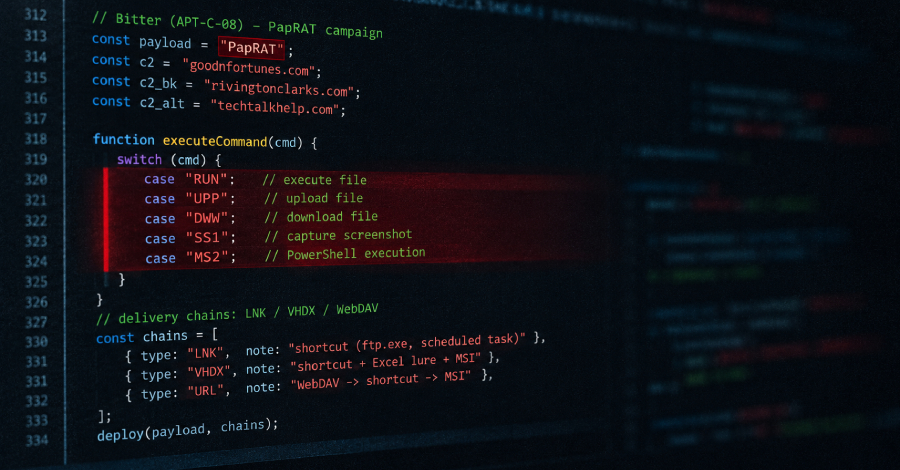
Bitter APT deploys new PapRAT malware
Fortinet FortiGuard Labs found PapRAT, a new remote access trojan used by the South Asia-focused group Bitter (TA397, Hazy Tiger). It comes in C++ and Rust versions. It can run commands, move and delete files, list drives and directories, and take screenshots. The Rust build adds PowerShell execution. It's delivered three ways: LNK files abusing ftp.exe, VHDX images with a decoy Excel file plus an MSI, and URL shortcuts that pull an LNK over WebDAV. One chain also drops Bitter's older WmRAT.
Key takeaways
- Block or closely watch LNK, VHDX and .url attachments and WebDAV fetches.
- ftp.exe running scripts or creating scheduled tasks is a strong hunting lead.
- C2 domains to block: goodnfortunes[.]com, techtalkhelp[.]com, rivingtonclarks[.]com.
 The Hacker News
"CopperDragon" malware supplier tied to three Chinese hacking clusters
Check Point Research describes CopperDragon as a possible "digital quartermaster" that supplies malware to China-nexus groups. Its tooling includes the Sparrow framework (linked to SparrowDoor and FamousSparrow) and the Melofee backdoor. Three clusters use it. SilentDelivery uses hacked websites showing fake Chrome certificate warnings. OceanGate pivots from internet-facing Linux servers into Windows networks in Asia. DarkWire targets Latin American telecoms and government ministries.
Key takeaways
- Shared tooling makes attribution murky. Track the toolset, not just the group name.
- A browser "Certificate Fix" download is a red flag for users and a good detection rule.
- Internet-facing Linux servers remain a common way into Windows environments.
 Alessandro Mascellino

Operation Snowball: an AI agent runs a telecom intrusion
Malbear Labs found an attacker's exposed working directory with more than 70 AI session transcripts. A likely Chinese-origin operator ran a custom agent on DeepSeek, with a jailbreak prompt of about 78,000 characters. The agent attacked a European telecom and 13 organizations hosted on its infrastructure for over two weeks. It got in through a Cisco BroadWorks XXE flaw (CVE-2026-20320), then old Liferay and JBoss bugs. When security tools blocked an exploit or tunnel, the agent switched tactics or wrote a replacement. Claimed data theft is unverified.
Key takeaways
- Attackers are already handing whole intrusions to AI agents and just checking in.
- Old, unpatched bugs (some from 2013 and 2020) were still enough. Legacy patching matters even more now.
- Treat internet-exposed end-of-life JBoss 6 as compromised, and watch for internal tunneling.
 Alessandro Mascellino

Ransomware & extortion
Vanderbilt University hit by BYOD ransomware gang
Vanderbilt found a ransomware attack on November 9, 2026. It told students and staff to shut down university devices and get off campus Wi-Fi. The BYOD group, active since September, claimed the attack. It says it has more than one million Social Security numbers, a claim that hasn't been verified. It also posted a video of a Vanderbilt computer playing a message about the breach. Most services, including Okta, Outlook and Zoom, came back by the next day. Note: "BYOD" is just the gang's name. It has nothing to do with personal devices.
Key takeaways
- BYOD is a new group aimed at universities and healthcare. Watch its leak site if you work in those sectors.
- Shutting down hard contains the damage but disrupts everyone. Plan how you'll communicate with users ahead of time.
- Expect follow-up phishing and credential attacks on affected students and staff.
 Keely Quinlan

Maersk confirms breach as WhiteArmor demands $5 million
Maersk confirmed that an attacker broke into a legacy system from a company it acquired and stole data. The new WhiteArmor gang claims about 100 GB from the LF Logistics platform (acquired in 2022). It is asking for $5 million in Bitcoin within 30 days. The gang says it has driver credentials and about 27,800 mobile device logs. Maersk says the incident is contained, and that so far no sensitive data appears to have been exposed.
Key takeaways
- Acquired companies' old systems are a common weak spot. Bring them up to your security baseline fast, or shut them down.
- Claims of plaintext driver passwords mean credential-stuffing risk for logistics partners.
- WhiteArmor is new. Track it as an emerging group going after big brands.
 Bill Toulas

Who runs the Qilin ransomware group?
KrebsOnSecurity's investigation links Qilin's admin persona, "Haise," to Aleksey Mikhailovich Yakovtsev, a 36-year-old man in St. Petersburg. The trail ran through old aliases ("Rjun"), a shared Telegram handle, forum posts and leaked Russian government records. Data came from Intel 471, Flashpoint and others. Qilin is the most active ransomware operation right now, with at least 365 claimed victims in the past three months. The identification is an allegation, not a confirmed law enforcement finding.
Key takeaways
- Naming the admin won't slow Qilin. Russia doesn't extradite, so treat the group as fully active.
- Old OPSEC slip-ups stay findable for years. Reused handles and leaked records link identities together.
- Qilin is high-volume double extortion, so backups alone won't save you. Detect data theft early.
 Skip to content
Cloud, AI & supply chain risk
Hackers abuse trusted AWS access to breach multiple cloud environments
An unnamed attacker compromised two IAM users in Qubole's AWS account. From there, they assumed the unused cross-account roles that customers had set up to trust Qubole. Between October 14 and 26, they pulled secrets from Secrets Manager, SSM Parameter Store and Lambda environment variables. They checked stolen keys with TruffleHog and downloaded data from S3. Tens of companies were hit, and one lost millions of files. AWS says its own services were not compromised. Wiz, Sentra and Mandiant investigated.
Key takeaways
- Review CloudTrail from October 1 for AssumeRole calls from Qubole's AWS account.
- Remove unused third-party integrations. Old trust roles are open doors.
- Lock down remaining roles with least privilege and source IP conditions, and rotate any exposed secrets.
 Bill Toulas
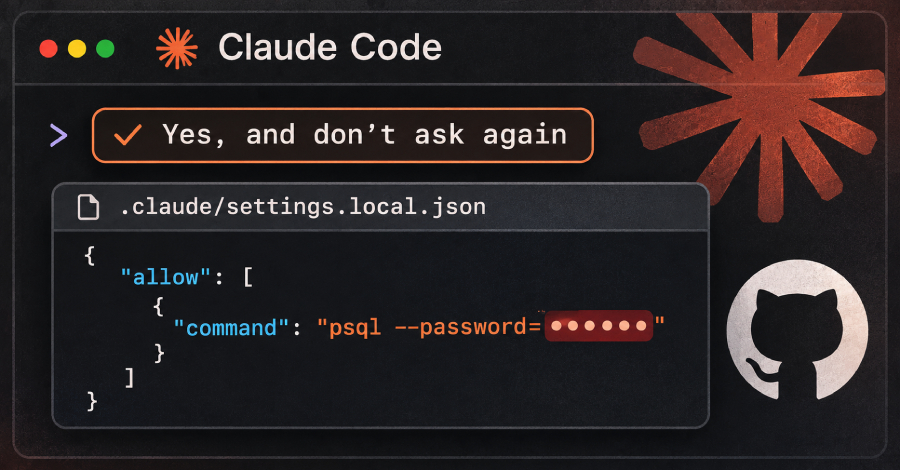
Claude Code's "don't ask again" option saves secrets in plain text
Apiiro found that choosing "Yes, and don't ask again" in Claude Code can save the exact approved shell command, including any password or token, to .claude/settings.local.json. That file is plain text. It isn't added to the project's .gitignore, so it often gets committed. Apiiro found 2,539 secrets across 1,994 public repos, including database passwords, SSH logins, tokens and AWS keys. One company confirmed its leaked key was live. No fix or CVE is mentioned, and the researchers say earlier bug reports were auto-closed.
Key takeaways
- Rotate any credential that ever appeared in
.claude/files, then remove them from git (git rm --cached) and add them to.gitignore. - Treat AI agent config folders as secret-bearing, and extend secret scanning to cover them.
- Use secrets-manager variables in commands, and approve command patterns rather than one-off commands.
 The Hacker News
TypoPrompting: typo domains for AI tools lead to malware
Island researchers found 186 lookalike domains for 27 AI brands, including ChatGPT, Claude, DeepSeek, Perplexity and Cursor. A mistyped address like "cloude.ai" goes through a traffic distribution system that picks a lure based on your OS and browser. Windows users get ClickFix pages that ask them to paste a PowerShell command into the Run box. Others get a Microsoft Store-signed "Net Guard" app that hijacks the browser, or Chrome extensions that redirect searches. One extension kit still had about 972,000 users.
Key takeaways
- Give staff bookmarks or direct links to approved AI tools, and watch for lookalike domains.
- A real verification page never asks you to paste a command. Teach users that.
- Detect browser activity followed by Run-dialog or Terminal use, and lock the default search provider.
 Tushar Subhra Dutta
Fraud, law enforcement & regulatory
Operation Endgame dismantles Gootloader, CastleRAT and StealC
Europol, Eurojust and police from nine countries took down 235 servers and 257 domains between November 9 and 11, 2026. Gootloader lost 14 servers and 218 domains, and 681 hacked websites were cleaned. CastleRAT lost 120 servers and 39 domains, and StealC lost 102 servers. Investigators recovered about 6.4 million stolen logins. CastleRAT victim data is going to notification services such as Have I Been Pwned.
Key takeaways
- These three tools are how attackers get in before ransomware. Taking them down disrupts many gangs at once.
- Check Have I Been Pwned and your threat intel feeds for exposed corporate credentials.
- WordPress site owners: rotate credentials, turn on MFA and patch. Gootloader runs on hacked sites.
 Sergiu Gatlan
AI deepfakes of CEOs and lawyers used to steal at least $129 million
The Justice Department unsealed charges against three men who allegedly used AI-generated voices and images to impersonate CEOs and lawyers at large law firms. From July 2024 to February 2026, they targeted finance staff who could approve big wire transfers. Victims included a UK fintech (about $11.6M), US hospital systems, a bank and a pet food company. The money was moved through accounts in many countries and converted to crypto. All three were arrested in Spain or the UK.
Key takeaways
- Deepfake BEC is now an organized operation, not a demo. A familiar voice or face no longer proves who you're talking to.
- Verify any urgent or confidential wire request through a separate, known channel before money moves.
- Train finance teams to spot the "secret deal plus outside lawyer" story and fake NDA e-signature emails.
 Matt Kapko

Perry Johnson settles with four state AGs over 13M-record breach
Perry Johnson Companies will pay $300,000 to Connecticut, New Jersey, New York and Michigan over a March 2023 breach. It faces another $9.7 million if it doesn't make required security fixes. Attackers got in with one employee's credentials, and there was no MFA. They stayed about two months, taking unencrypted health data on more than 13 million people. Monitoring tools logged the activity but weren't set up to alert anyone. The company reportedly learned of the breach from the hackers.
Key takeaways
- Missing MFA and unencrypted data are now costly in regulatory settlements.
- Logging is pointless if nothing alerts on it. Tune detections and test them.
- Settlements now require specific controls: MFA, encryption, yearly risk assessments and data retention rules.
 Suzanne Smalley

Bogotá health agency email linked to European bomb-hoax wave
A bomb-hoax email that diverted Finnair and Aer Lingus flights to Rome came from the email domain of Subred Sur Occidente, a public hospital network in Bogotá. The wider hoax wave has disrupted dozens of flights, and no explosives were found. Many messages were signed in the name of a Russian misogynist movement banned in Russia, but experts warn against attributing it on that basis. Bogotá is checking whether the account was hacked or the address was spoofed.
Key takeaways
- Weak email authentication can let attackers misuse a public agency's domain. Check your SPF, DKIM and DMARC.
- Don't attribute based on a signature line alone. False flags are cheap.
- Hoax campaigns cause real operational damage (diverted flights, escorts) even without any malware.
 Alexander Martin