Threat Newsletter October 26, 2026

The week's big story is speed. PHP2Shell was exploited four days before patches existed, Storm-0940 went from target to privileged cloud access in under three hours with an AI pentest tool, and one hacker's AI agents breached 100+ sites for about $50 each. Meanwhile trusted delivery channels kept failing: LiteLLM, Rank Math PRO and ConnectWise app identities all became attack paths, and a CA's own keys turned out to be recoverable.
- Patch first: PHP2Shell (and PAN-OS hotfixes Oct 26–30), BeyondTrust Remote Support, PAN-OS CVE-2026-0257, Splunk/SolarWinds.
- Hunt now: LiteLLM 1.107.0, Rank Math PRO installs from Oct 15–16, ConnectWise app consents in Entra ID, OpenCode-linked API keys.
- Watch: ClickFix's growing kit of signed binaries, StealC's comeback as Stadia, and AI agents collapsing attacker cost.
Vulnerabilities & Active Exploitation
PHP2Shell exploitation started four days before patches
Amazon Threat Intelligence saw attackers hitting its MadPot honeypots with PHP2Shell exploits (CVE-2026-109618 and CVE-2026-109619) on October 17, four days before PHP shipped emergency fixes on October 21. Details leaked during the embargo, forcing PHP to pull its release forward. Amazon now calls exploitation broad, though Dataminr says it has seen mostly scanning and non-working exploits so far. VirusTotal tracks more than 5.1 million exposed PHP hosts.
Key takeaways
- Patch PHP now. The UK NCSC says take unpatched servers offline.
- Don't treat disclosure day as day zero. Hunt back to at least October 17.
- PHP runs WordPress, Drupal and Joomla, so the blast radius is huge.
 Sergiu Gatlan
Palo Alto confirms PHP2Shell hits PAN-OS
Palo Alto Networks confirmed the two PHP2Shell flaws affect PAN-OS 10.2 through 12.2 and Panorama, rated 8.7 for its products. Exposure is limited to the management web interface and XML API; GlobalProtect is not affected. Cortex XCORE SaaS and WildFire Cloud were fixed October 21–22. PAN-OS hotfixes are scheduled from October 26 to October 30. No exploitation against Palo Alto products is known yet, but Unit 42 has seen proof-of-concept code.
Key takeaways
- Lock management interfaces to trusted IPs or a jump box until hotfixes land.
- Threat Prevention signature 543004 helps, but only if management traffic is inspected.
- Track your exact hotfix version; release dates are estimates.
 Guru Baran
Splunk and SolarWinds ship fresh patches
Splunk fixed 16 CVEs in Splunk Enterprise, including two critical flaws (CVE-2026-76299 and CVE-2026-76302), in versions 9.4.16, 10.0.11, 10.2.8 and 10.4.4. Splunk SOAR 8.7.0 fixes 15 more plus a dozen third-party library bugs. SolarWinds patched a high-severity authorization flaw in Observability that lets low-privileged users see restricted data, plus XSS, SSRF and a Patch Manager info leak. No exploitation is reported.
Key takeaways
- Your SIEM and monitoring stack is high-value infrastructure. Patch it like an edge device.
- Target versions: Splunk Enterprise 9.4.16 / 10.0.11 / 10.2.8 / 10.4.4, SOAR 8.7.0, SolarWinds Observability and Patch Manager 2026.4.
 Ionut Arghire
Rank Math PRO update channel served a self-restoring backdoor
Rank Math PRO copies downloaded or auto-updated from rankmath.com between 20:02 UTC October 15 and 07:12 UTC October 16 contained malware. The backdoor rebuilds itself when the site is visited and may plant admin accounts, cron jobs, SSH keys and PHP files across other plugins and themes. Wordfence assigned CVE-2026-111862 (CVSS 9.8). Clean version 3.0.124 is out, but updating alone does not clean a site. The C2 domain rank1cdn[.]com was registered about a day before the window opened.
Key takeaways
- If you activated a copy in that window, treat the site as compromised, even if you've since updated.
- Restore from a backup taken before October 15 if you can, then rotate every secret.
- Hunt for admins starting
wpsupport_,@wp-mail[.]netemails, andwp-includes/class-wp-cache-util.php. - Third vendor-run WordPress update channel backdoored this year. Premium plugin updates are supply chain risk.
 The Hacker News
Siemens Software Center abused in ClickFix attacks
Attackers paired a genuine, signed Siemens Software Center binary with malicious DLLs to side-load malware onto Windows PCs (CVE-2026-110936, CVSS 8.4). Victims arrived through ClickFix lures. Siemens ties the activity to Romulus, a ClickFix delivery platform Forescout documented last week that also pushes LegionLoader. Version 4.0.9.8 fixes the flaw and updates automatically on launch. Siemens says none of its systems or update channels were breached.
Key takeaways
- The signed file is legitimate, so hash blocking won't help. Detect on behavior and folder paths.
- Watch for signed apps from Siemens, Canon and Stardock loading DLLs from user-writable folders.
- ClickFix keeps finding new signed binaries to hide behind.
 Eduard Kovacs

Nation-State Activity
Chinese spies exploit BeyondTrust Remote Support zero-day
BeyondTrust, Mandiant and Google confirmed CVE-2026-102764, a zero-day in BeyondTrust Remote Support appliances, exploited since August 29. Mandiant tracks the actor as Armory Castle (UNC5221), a China-nexus espionage group behind earlier Ivanti and Citrix zero-days. The attackers dumped every credential the appliance stored, moved laterally, and planted Sawfly and Bareclaw malware that survives reboots and config resets. A patch is out. Google warns this group usually shifts to mass exploitation once a bug goes public.
Key takeaways
- Treat any internet-reachable, unpatched appliance as compromised until reviewed.
- Rotate every credential the appliance held. That's the real prize here.
- Expect a wave of opportunistic exploitation now that the bug is public.
 Jonathan Greig
ConnectWise breach let Chinese spies hit 2,250 Microsoft 365 tenants
Microsoft says Storm-0940, a China-linked espionage group, used compromised ConnectWise application credentials and ARTEX, an open-source AI pentest framework, to target more than 2,250 Microsoft 365 tenants. After password spraying 327 accounts failed, the group pivoted to permissions customers had already granted ConnectWise apps, with no user login needed. Attempts peaked at 2,900 a minute, and some environments went from target to privileged access in under three hours. ConnectWise shut down Cloud Backup, SaaS Security and Cloud Management while it investigated.
Key takeaways
- Audit third-party app consents and service principals in Entra ID. Revoking the vendor's creds doesn't remove persistence.
- Look for Graph API activity changing app credentials or privileges.
- AI didn't invent new techniques; it compressed the timeline. Detection windows shrink accordingly.
 Carly Page
APT28 breaches NATO naval shipbuilder
Symantec tied APT28 (Fancy Bear) to intrusions at a law enforcement agency, a naval shipbuilder and a military aircraft engine maker in two NATO states. At the shipbuilder, operators returned hands-on-keyboard over a week, stealing credentials two ways (a planted SSH key and a loopback NTLM capture), opening a persistent SSH tunnel, and dropping a new reflective loader. Newer HOOKEDGE variants dropped webhook[.]site for a dedicated IP, 185.82.218[.]119. The last observed activity was September 24.
Key takeaways
- Defense-industrial base is squarely in APT28's sights. Macro-enabled Word docs are still the way in.
- Alert on outbound SSH from Windows hosts and loopback NTLM authentication.
- Block or flag webhook[.]site and the listed IP.
 The Hacker News

Malware & Ransomware
StealC's seller returns with Stadia RAT
Four months after Operation Endgame seized 326 StealC servers and 142 domains, the same seller ("plymouth") is advertising Stadia, a Windows RAT that adds hidden VNC, a remote shell, a loader, file and process management on top of credential theft. Varonis found a browser-decryption helper byte-for-byte identical to StealC 3.5. Stadia targets 50+ browsers, 120 crypto extensions and 50 desktop wallets, persists through a hidden scheduled task every 15 minutes, and adds itself to Defender exclusions. Subscriptions run $300 to $900 a month, with a free Pro month for former StealC buyers.
Key takeaways
- Takedowns slow operators; they don't end them. Code reuse brings them back fast.
- Hunt for unsigned processes spawning suspended Chrome/Edge/Brave and injecting code.
- Flag new
Add-MpPreference -ExclusionPathcalls and hiddenPT15Mscheduled tasks. - C2 IPs rotate per build. Behavior detections will outlast IOC blocks.
 Tushar Subhra Dutta
Qilin and INC ransomware exploit PAN-OS flaw to skip MFA
Unit 42 says Qilin and INC affiliates are exploiting CVE-2026-0257, a PAN-OS and Prisma Access authentication bypass patched in May, to set up VPN sessions and bypass MFA. After getting in, they use RMM tools for recon, move over RDP and SMB, and in one case jumped straight to vCenter, disabled ESXi's execInstalledOnly protection, and dumped credentials offline from a domain controller's VMDK. That sidesteps in-guest EDR entirely. They also hit Veeam backups via CVE-2023-27532.
Key takeaways
- Patch CVE-2026-0257 if you haven't. It's been on CISA KEV since May.
- Hunt for unexpected successful GlobalProtect gateway connections.
- Protect the hypervisor layer: vCenter access, ESXi settings, and VMDK reads deserve their own alerts.
- Patch and isolate Veeam. Backups are always on the target list.
 The Hacker News
CikaBika Bot RAT runs its C2 through Discord
Darktrace found a phishing campaign delivering CikaBika Bot, a Rust RAT controlled entirely over Discord. A disk image with a malicious LNK and decoy PDF launches a Nim loader, which tries a PowerShell UAC bypass and DLL search-order hijacking against Microsoft Edge. Once running, the RAT gives each victim its own Discord channel, then handles recon, command execution, screenshots and file theft. Bulk data leaves as ZIPs over ngrok.
Key takeaways
- Legitimate services make cheap, hard-to-block C2. Baseline who in your org actually talks to the Discord API.
- Correlate LNK → PowerShell → computerdefaults.exe and the ms-settings registry key.
- Watch for unexpected DLLs (such as dbghelp.dll) in the Edge install folder, and for ngrok traffic.
 Ionut Arghire
Supply Chain & AI Security
LiteLLM hit by a second supply chain attack
Attackers slipped malicious commits into LiteLLM's release pipeline through a look-alike GitHub org (Berri-AI vs. the real BerriAI) and shipped version 1.107.0 to PyPI and Docker on October 21. A .pth file runs an infostealer every time Python starts; it grabs browser creds, AWS/GCP/Azure tokens, IMDS metadata, LLM API keys, SSH and GPG keys and shell history across 16 modules. A sitecustomize.py RAT polls for commands hourly. Data goes out AES-encrypted to www[.]litellm[.]dev/healthcheck. LiteLLM sees about 23 million weekly downloads; the last safe version is 1.106.2.
Key takeaways
- If you ran 1.107.0 anywhere, including the
latest,main-latestormain-stableDocker tags, assume every secret on that host is gone. - Check for
/tmp/.pc_once_*(exfil fired) and/tmp/remote_code_loader.lock(C2 daemon ran). - Pin versions for AI gateways. They sit next to your most valuable keys.
 Jessica Lyons

OpenCode breach leaks API keys during an AI distillation attack
OpenCode, an open-source AI coding agent, said a large-scale distillation attack exposed stored provider API keys for 1.4% of its Console users who had linked Anthropic, OpenAI or Google accounts. The attack ran at least 48 hours and used AI agents. Users reported up to $1,700 in overnight charges and some Google Cloud projects suspended for abuse. Earliest exposure was 00:30 UTC on October 17. OpenCode says it may reimburse affected users.
Key takeaways
- If you linked provider keys to OpenCode Console, rotate them now and check billing.
- Set hard spend caps and alerts on every AI provider account.
- Stolen API keys are now worth money twice: for compute and for model distillation.
 Bill Toulas
One hacker, AI agents and about $5,000 breach 100+ sites
orForge researcher Snorre Fagerland watched a Chinese-speaking hacker hand an intrusion campaign almost entirely to AI agents running on Cairn, an open-source agent coordination platform left exposed online. Starting September 25, the agents tried more than 1,200 sites, mainly online stores in the US, Canada, Australia and Japan, and broke into over 100, including Deere, SharkNinja and Cummins. Reported token spend was around $5,000, roughly $50 per breach. How much data was taken is not confirmed.
Key takeaways
- Attack cost has collapsed. Expect more volume against mid-tier web apps.
- Agents chain small weaknesses (session storage, object handling) rather than one big bug. Fix the medium findings.
- Unsecured agent dashboards leak both attacker and victim data. Lock down your own.
 Guru Baran
DHS orders DeepSeek out of federal civilian IT
DHS ordered federal civilian agencies to remove DeepSeek products, plus third-party products and services built using DeepSeek, and barred new purchases. The order was signed July 24 under the 2018 Federal Acquisition Supply Chain Security Act and published in the Federal Register on October 20. It covers civilian agencies only, not defense, intelligence, state governments or the private sector. Coverage cites China-based data storage, PII collection and possible transfer of government data. Agencies must remove the products or seek an exception.
Key takeaways
- Vendors selling to civilian agencies need to know whether anything they ship runs on DeepSeek models.
- Contractors with the FASCSA clause must check SAM.gov and report covered products.
- Until removal is done, agencies should tighten logging and exfiltration controls.
 Bill Toulas

Defensive Moves & Industry
Chrome adds ClickFix detection and warns before HTTP connections
Google added ClickFix detection to Chrome's Enhanced Protection: when a user copies a suspicious command, Chrome strips PII from the clipboard payload, sends it to Safe Browsing, and warns if the verdict is dangerous. Gemini-based scam detection moved server-side and now covers fake antivirus and fake browser updates. Safe Browsing also gained a lower-confidence "suspicious site" warning. Separately, Chrome now asks before connecting over plain HTTP for everyone by default; Google says about 95% of desktop users see no such warning in a typical week.
Key takeaways
- First browser-level control aimed squarely at ClickFix. Push Enhanced Protection via policy if you can.
- It's a speed bump, not a fix. Keep restricting Run dialog, PowerShell and mshta for regular users.
- Internal sites on bare HTTP will start prompting; plan for helpdesk questions.
 Eduard Kovacs

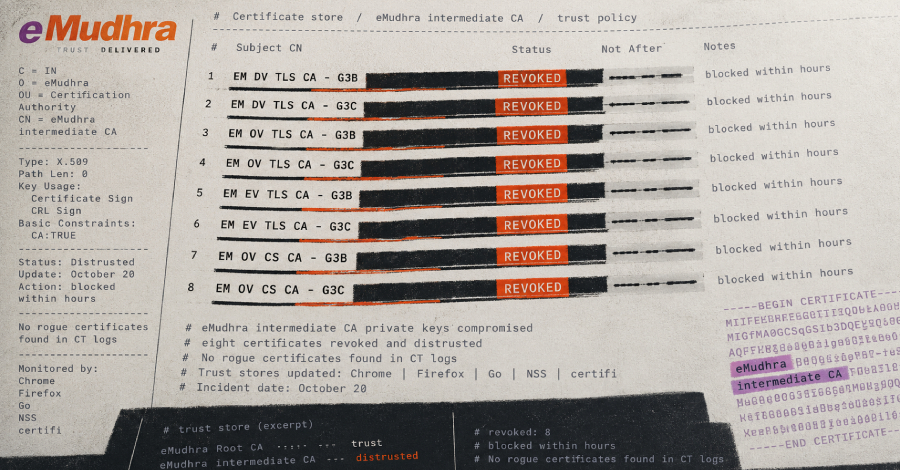
Eight compromised eMudhra CA keys put the internet on alert
A researcher proved on October 17 that the private keys for eight eMudhra intermediate CA certificates could be recovered from the certificates themselves, because they were generated incorrectly in an April 2025 key ceremony. Six were TLS intermediates that could have signed a trusted cert for any website. Chrome and Firefox blocked them within hours, Apple and Microsoft by October 20–22, and eMudhra revoked all eight on October 18. eMudhra says none issued end-entity certificates, and no malicious use has been confirmed. Go, Composer's ca-bundle and others shipped emergency trust-store updates.
Key takeaways
- Browsers are covered. Non-browser clients with bundled trust stores (SDKs, appliances, language runtimes) may not be.
- Update Go and Composer ca-bundle (1.6.0 / 1.4.16), and check what trust store your vendors' products ship.
- Revocation only helps clients that check it. This is a third-party risk question as much as a patching one.
 The Hacker News
Proofpoint to buy Varonis for $6.3 billion
Thoma Bravo-owned Proofpoint agreed to acquire Varonis in an all-cash deal worth $6.3 billion. Proofpoint brings email and identity threat defense; Varonis brings data visibility and security. The combined company would serve more than 16,000 enterprises and is pitched as a data and AI security platform covering sensitive data discovery, access control for people and AI, and data loss prevention. It follows Accenture's move on Dragos and Cyera's $1 billion Oasis buy this year.
Key takeaways
- Data security is consolidating around AI governance: who and what can touch your data.
- Varonis customers should watch for roadmap and licensing changes after close.
- Both firms keep strong research teams; hopefully that output continues.
 Joe Warminsky